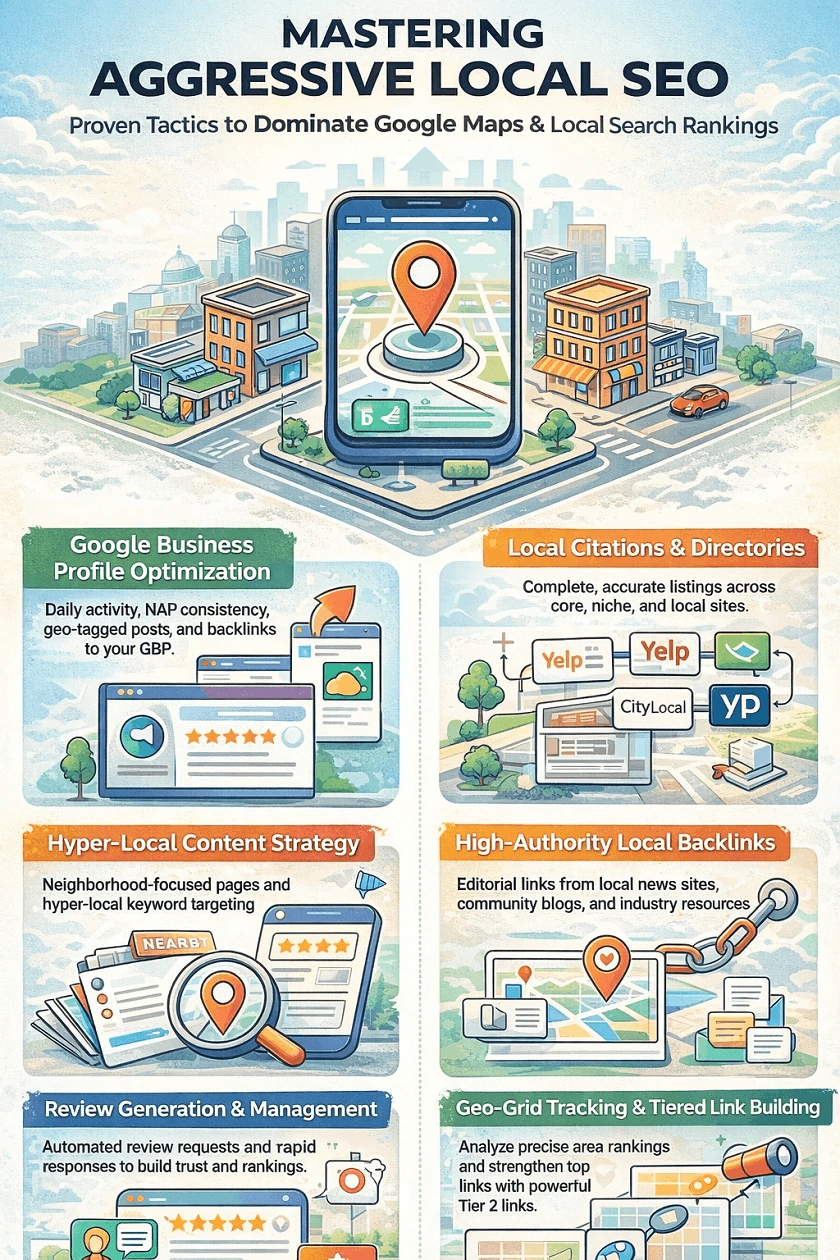
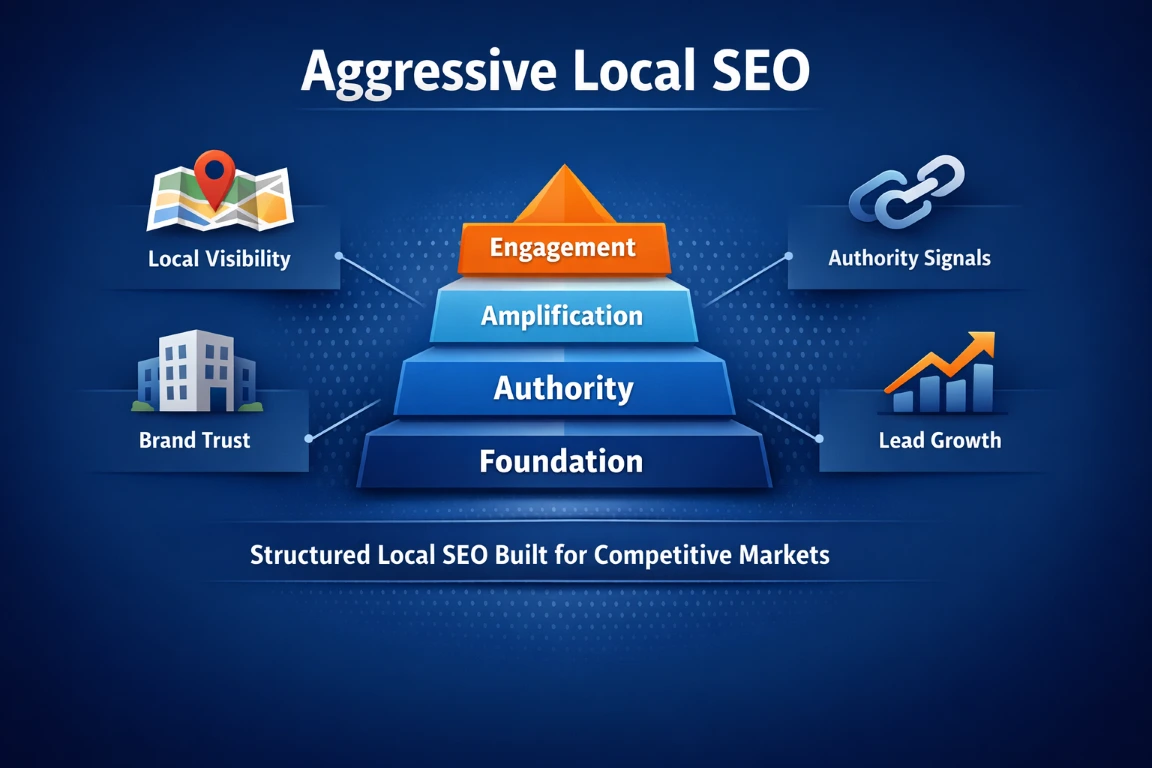
Aggressive Local SEO is a multi-layered ranking strategy designed to accelerate visibility by strengthening every local ranking signal Google uses.
Instead of relying on one tactic (like citations or backlinks alone), aggressive Local SEO focuses on:
This approach is essential for businesses competing in saturated markets where standard Local SEO is no longer enough.
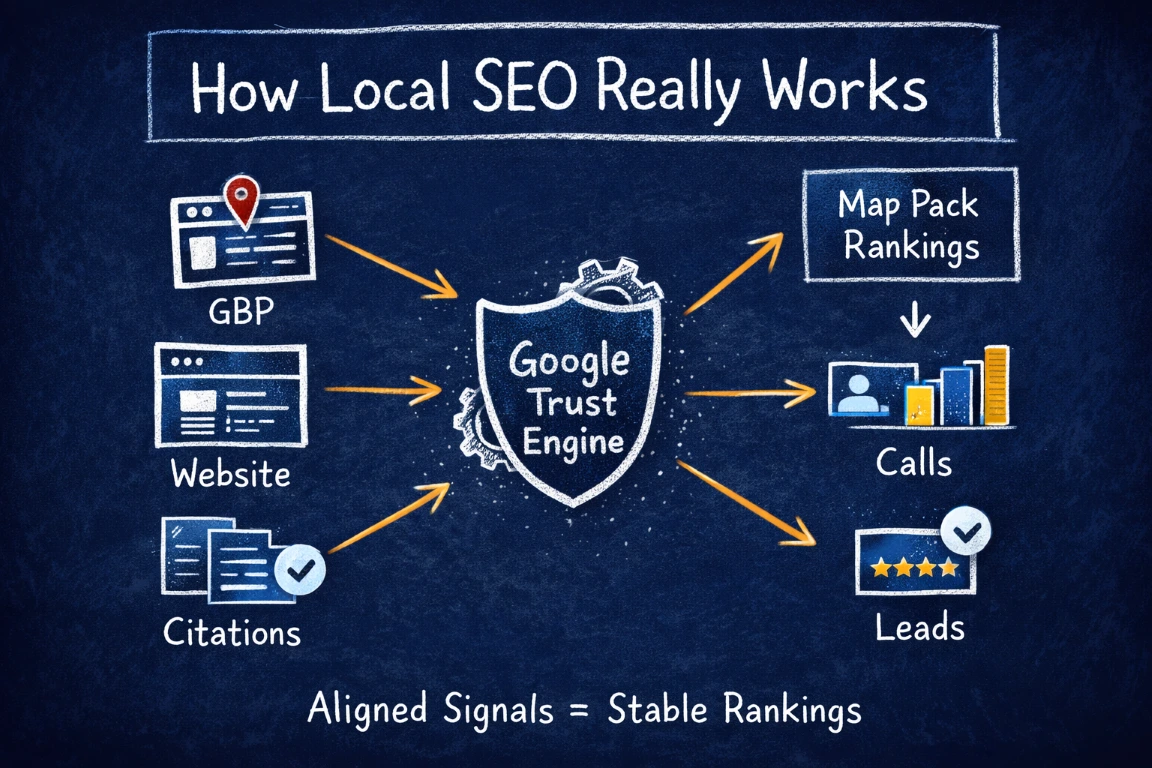
Google no longer ranks “websites” in isolation. It ranks entities.
Your business is evaluated using multiple overlapping systems:
If any of these are weak, rankings stall. That’s why most local SEO campaigns fail.
This guide shows how to build all of them together.
The Core of Local Rankings
Your Google Business Profile is the #1 driver of local visibility – and if it’s incomplete, inactive, or inconsistent, you can be invisible in the Map Pack even if your website SEO is good.
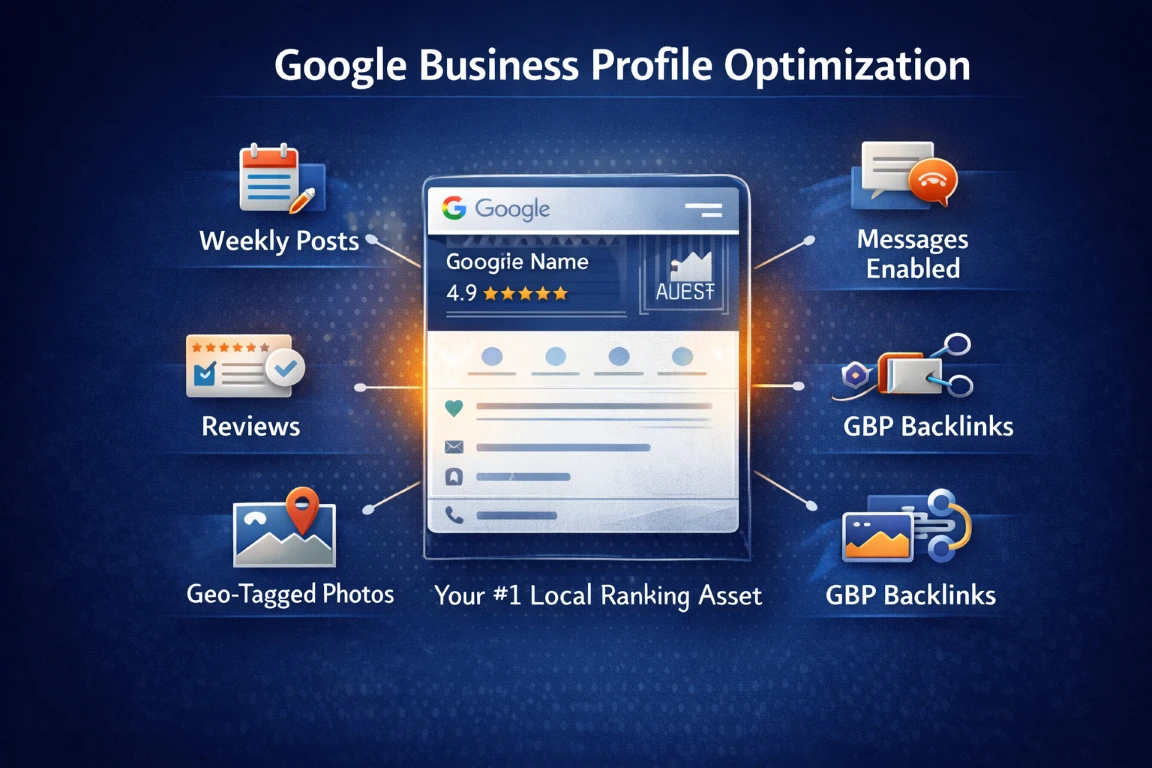
We treat GBP like a high-conversion landing page, not just a directory listing.
Without a fully optimized GBP, your local SEO has no foundation, and this layer directly supports calls, direction requests, messages, and visibility.
The guide notes GBP optimization can increase profile views by 100–300% and signals freshness/relevance/legitimacy to Google.
A fully optimized GBP acts as the command center for all other Local SEO strategies.
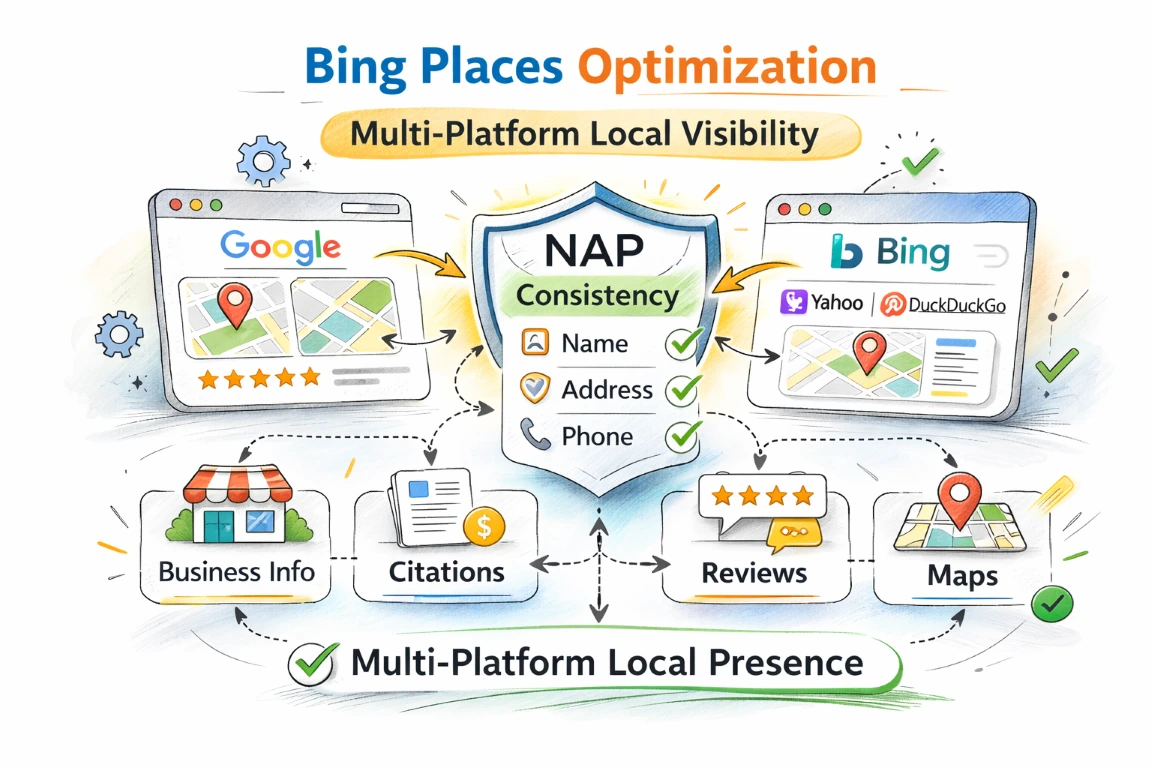
Don’t Ignore the Second Search Engine. Bing powers Yahoo, DuckDuckGo, and Microsoft Start, and can drive qualified traffic—especially in B2B, enterprise, and older demographics.
This layer ensures you appear consistently across major search ecosystems.
Sync with GBP data (exact NAP, categories, hours—no discrepancies)
Better NAP trust (consistency reinforces legitimacy in Bing’s local algorithm)
Extra authority (Bing Places can earn backlinks and visibility on Microsoft properties)
The guide emphasizes many agencies skip Bing, but this layer can:
The Trust Grid Google Cross-Checks
Google verifies your business by cross-checking your NAP across hundreds of directories and data sources.
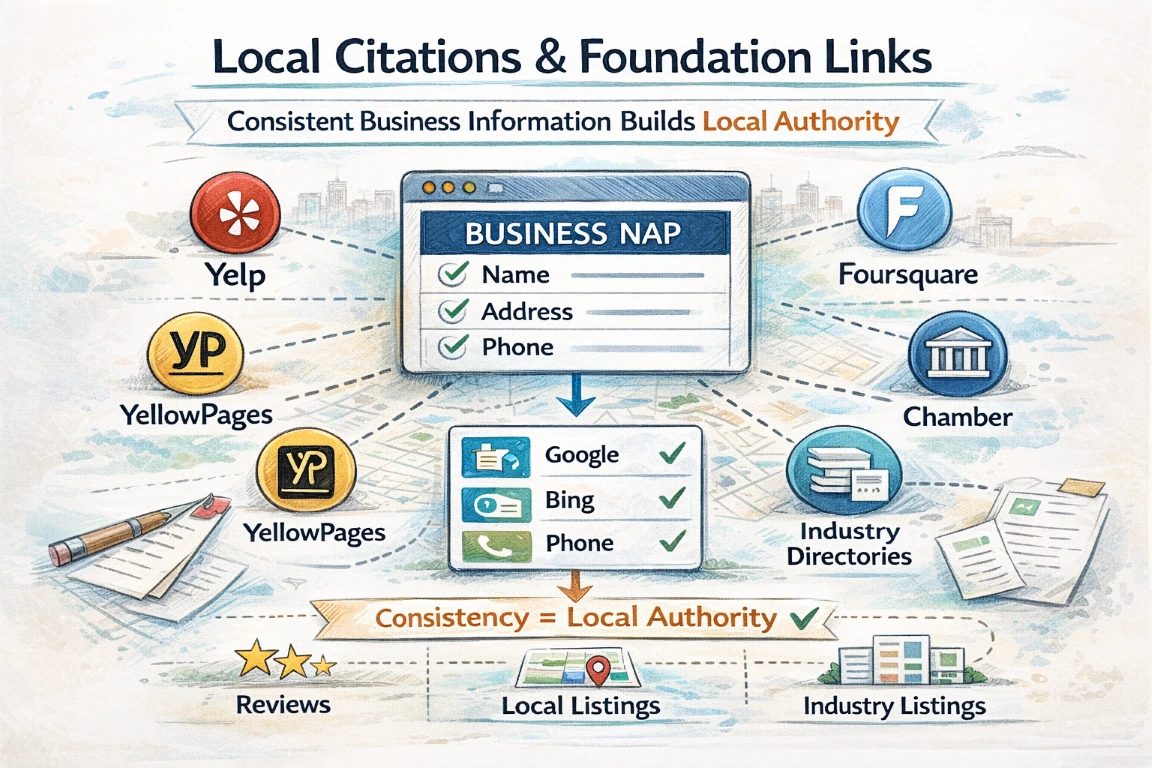
If your information is inconsistent—even a typo—your business can lose trust, authority, and rankings.
The guide summarizes citation benefits as:
In simple terms:
more consistent citations → higher trust → higher rankings → more calls and leads
A triple layer strategy. We don’t submit random directories—we build a structured ecosystem.
Layer 1: Top citations (core directories)
Examples include Yelp, Yellow Pages, Hotfrog, Foursquare.
Layer 2: Niche citations (industry specific)
Niche directories outperform generic ones by improving relevance.
Layer 3: Hyper-local citations (city/community trust)
Chambers of commerce, local associations, city directories, community forums—critical for competitive service areas.
We analyze top competitors and extract the citations they use – if they have it, you get it; if they don’t, we build better.
Before building, we audit for incorrect NAP, duplicates, incomplete profiles, wrong categories, and outdated details – then fix everything so Google sees one clean version.
Injecting Real Local Authority
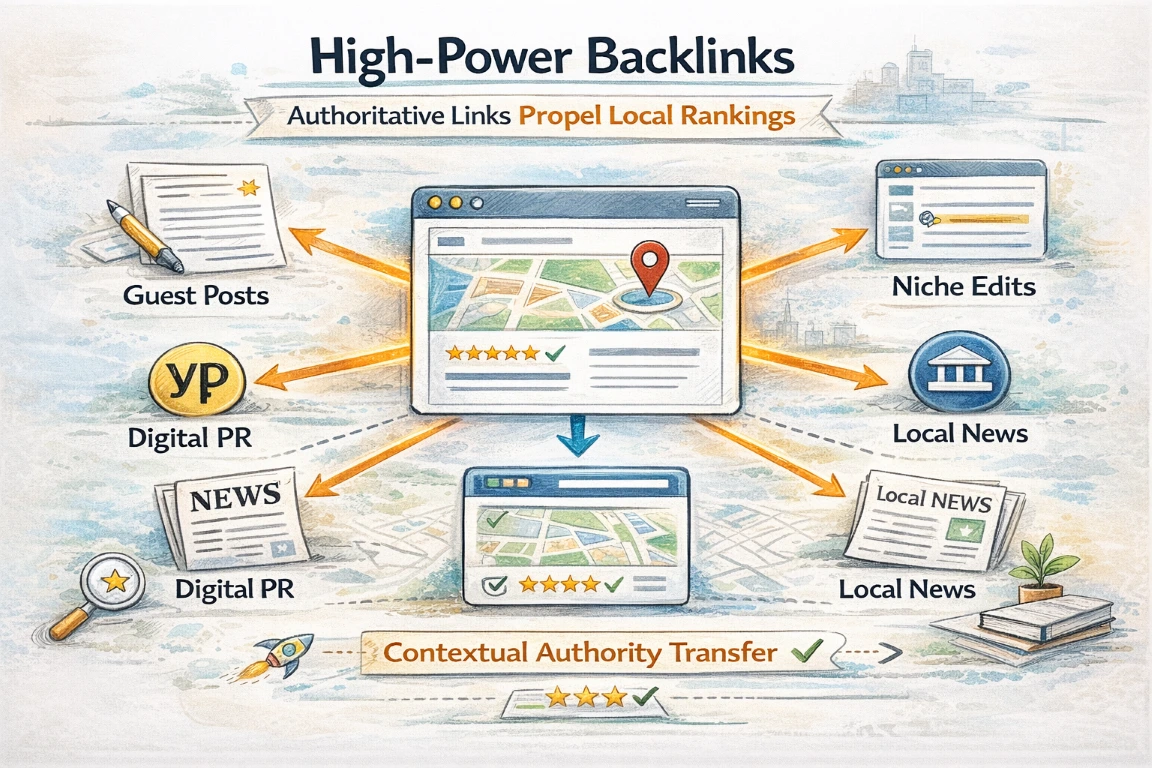
Not all links move the needle—this focuses on editorial, contextual, high-impact placements.
Amplify What You Already Earned
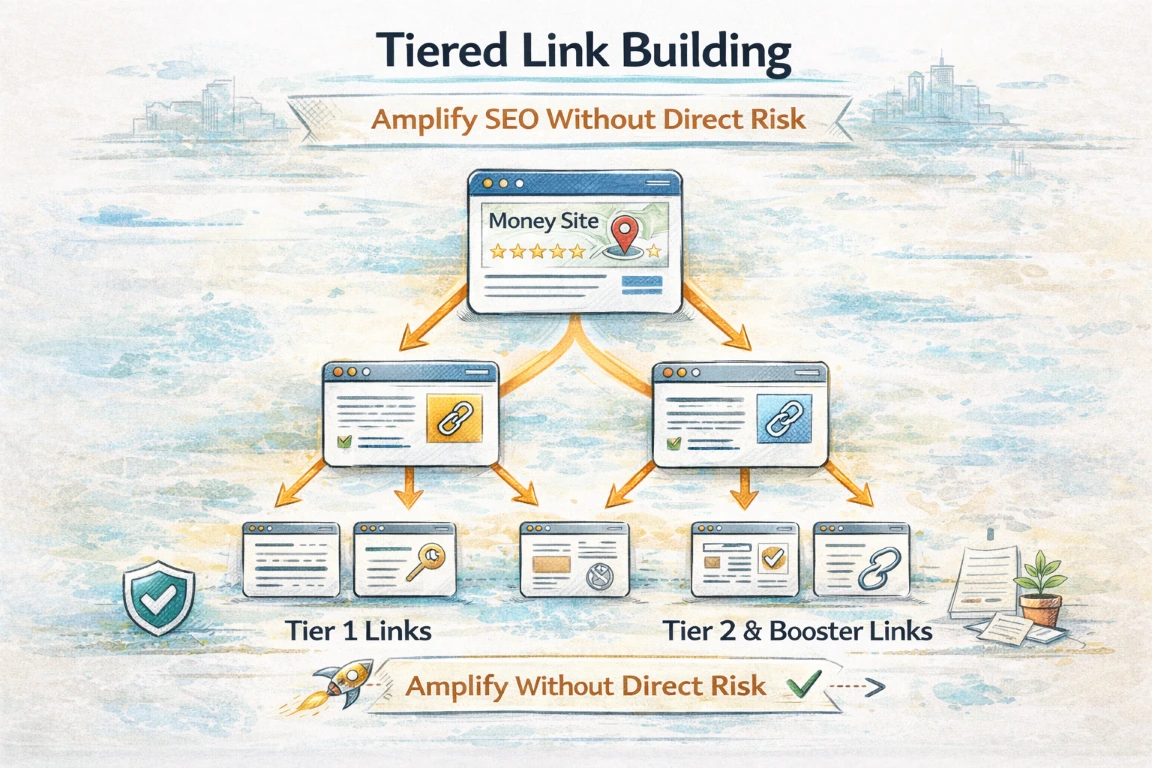
Once you have strong Tier 1 links, you can increase their impact with a structured tiered setup.
Step 1: Identify Tier 1 links (guest posts, niche edits, parasite pages, crowd/forum links).
Step 2: Send booster links (social bookmarks, pastebin-style links, link-in-bio/profile links, contextual blog/wiki links).
Step 3: Tier 2 & indexing (web 2.0 submissions, wikis, article directories, extra bookmarks, indexing services).
Turn Local Searches Into Real Engagement
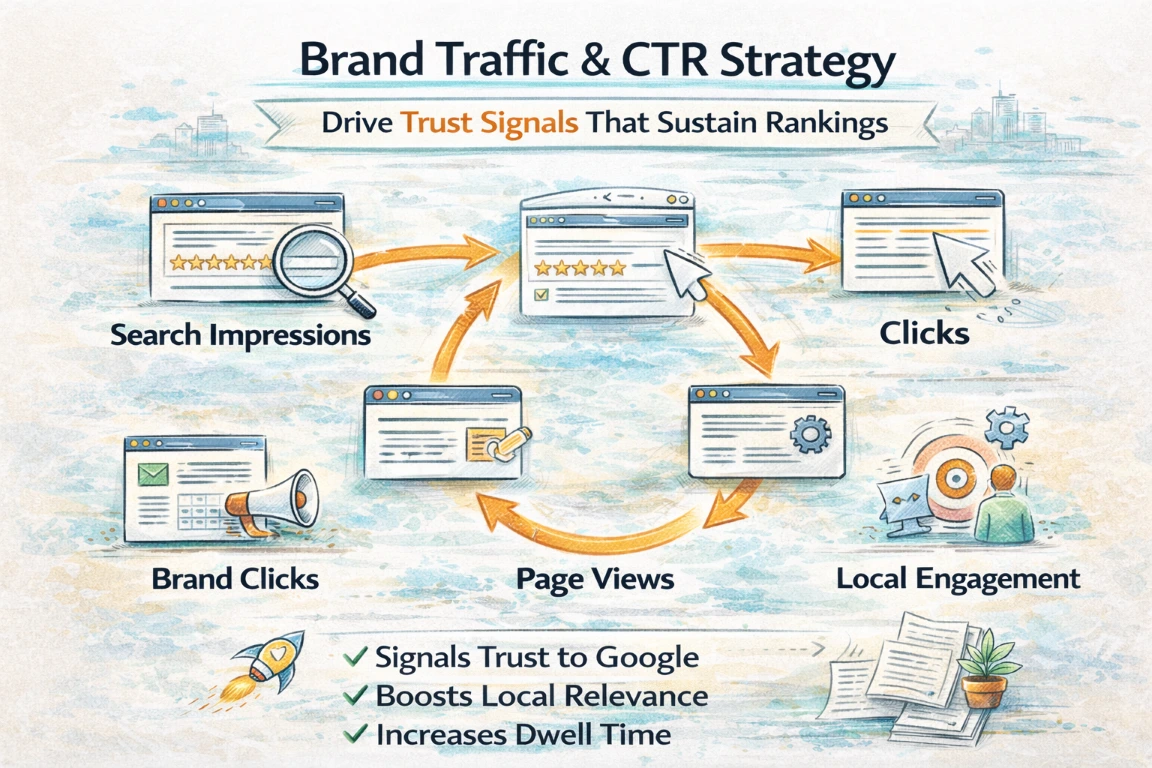
Google watches how users interact with local listings. If users click, stay, and take action, Google assumes relevance and can reward rankings.
The guide focuses on measurable engagement signals: search CTR, dwell time, on-page engagement, and return/direct visits.
Use this section on the landing page to frame a clean, white-hat approach (while still matching the guide’s intent):
Standard Local SEO |
Aggressive Local SEO |
|---|---|
 Basic citations Basic citations |
 Full citation ecosystem Full citation ecosystem |
| One-time GBP setup |
Ongoing GBP activity |
| Few generic backlinks |
Editorial authority links |
| No engagement strategy |
CTR & behavior optimization |
| Slow progress |
Accelerated growth |