
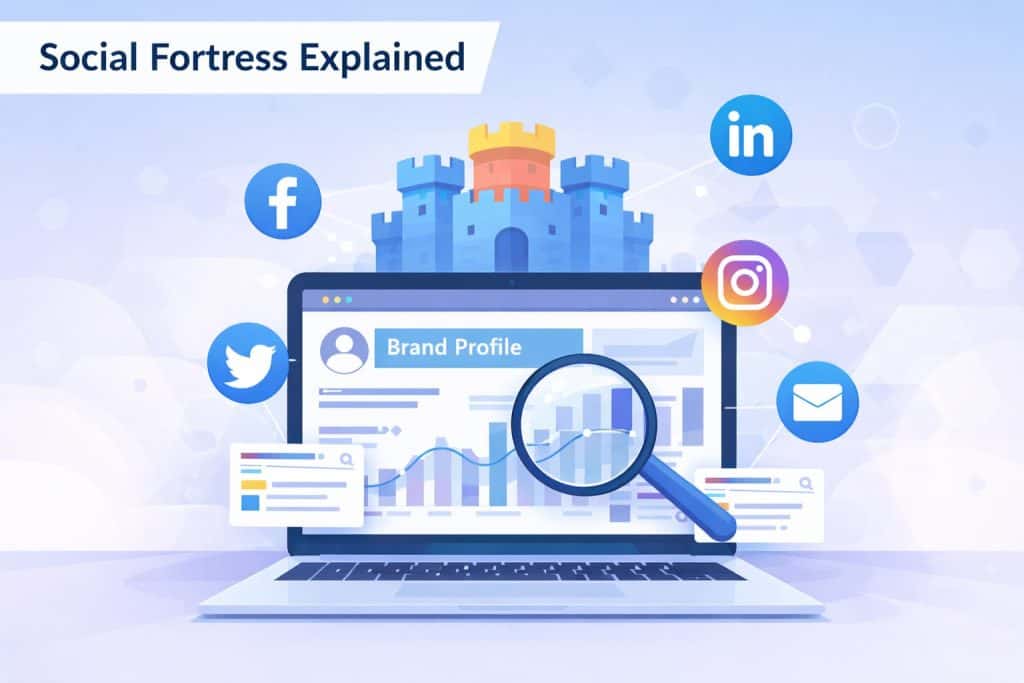
A social fortress is a network of branded social media profiles built to link back to your website, strengthen entity signals, and support rankings through diversified backlinks and branded search control.
The concept gained visibility in SEO communities after the mid-2010s, especially in niche blogs and private groups discussing entity building and branded profile creation. At its core, it looks similar to local citation building. The difference is that instead of listing your business in directories, you secure branded profiles across social platforms to establish your digital footprint.
Some services make it possible to register usernames on well over 100 social bookmarking sites, Web 2.0 platforms, and profile creation sites, helping you lock in consistent branding everywhere your name appears. That consistency matters because search engines compare details across sites to confirm ownership and legitimacy through entity recognition algorithms.
Google’s public guidance and patents show that consistent signals across multiple sites help its systems understand who owns a site and how a business entity should be identified, which strengthens entity recognition in search results.
A typical social fortress includes:
While traditional link building strategies focus on acquiring backlinks from external websites through guest posting, niche edits, or digital PR, a social fortress establishes your brand authority across social platforms that Google already trusts.
Recent data shows that,
“large majority of U.S. adults use major social platforms, with YouTube and Facebook among the most widely adopted” – Pew Research Center
It shows how dominant social media usage is in everyday online behavior. When your brand lives there consistently, it sends clean trust signals to search engines.
Key Insight: A social fortress is a foundation layer for your overall SEO strategy. Not a ranking trick, but essential brand signal infrastructure.

Social profiles on high-authority domains can rank for branded searches, helping you control what appears on page one when someone looks up your name—a critical aspect of online reputation management.
Platforms like Facebook, LinkedIn, and YouTube sit on domains (DA 90-100) that often rank easily for brand queries. When someone searches your brand, Google frequently shows:
That layered visibility builds familiarity and reinforces entity consistency signals across search results.
This visibility also aligns with broader platform reach trends. Pew-based reporting notes that,
“YouTube and Facebook lead U.S. social media usage” – Search Engine Journal
It highlights how these domains maintain strong authority and discovery power in search ecosystems, making them valuable for social media SEO strategies.
A social fortress can help with:
Some SEOs use light link wrapping, where profiles link to each other and to the main site. Done carefully, it reinforces network structure without creating obvious link schemes that search engines penalize.
The key is authenticity. Profiles should look active, complete, and real. If they feel automated or empty, the trust signal weakens and may hurt rather than help.
Important: A social fortress works best when it supports your brand, not when it tries to game search engines. This is white hat SEO when done properly.
Complement your social fortress with our local citation building services for maximum local SEO impact.
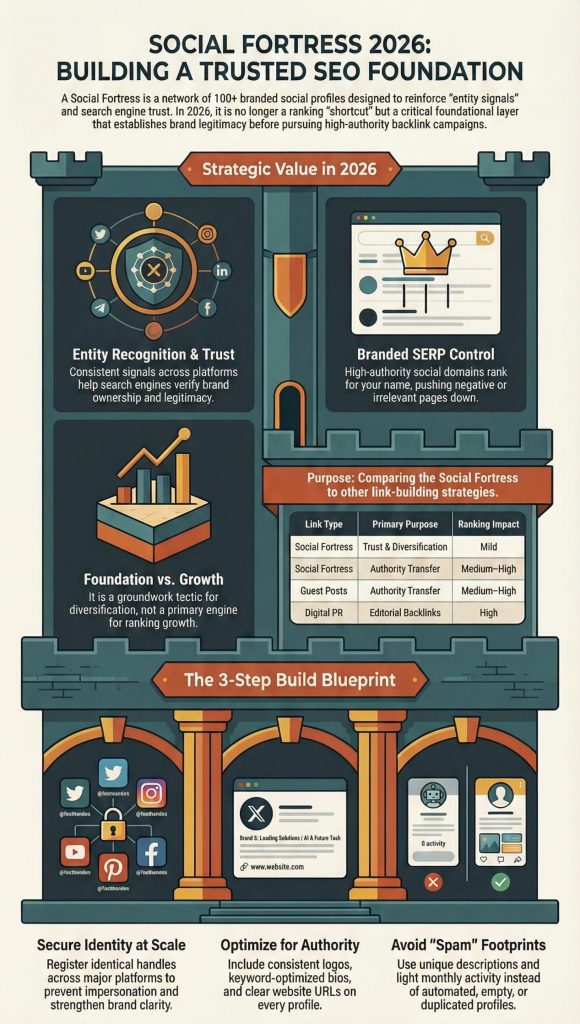
Build consistent branded accounts, optimize each profile, interlink them carefully, and keep them active over time. Here’s the proven social fortress setup tutorial:
Register your brand name across major platforms. Keep the handle as close to identical as possible. This prevents brand impersonation and strengthens entity clarity in search algorithms.
Best tools for username availability checking:
Each account should include:
Add cross-links where they make sense. The goal is structured reinforcement, not an obvious loop that triggers spam filters.
Pro Tip: Write unique descriptions for each platform. Use AI tools like ChatGPT to create 10-20 variations of your business description, then customize each for platform requirements.
Link wrapping can connect properties in a controlled way. Avoid mechanical patterns where every profile links to every other profile. Natural cross-references are safer and more durable.
Safe linking structure:
Log in monthly. Post small updates. Keep the accounts alive. Avoid automation tools that leave detectable patterns and risk mass suspensions.
Minimum maintenance schedule:
Critical Insight: Maintenance decides long-term value. Abandoned profiles fade in visibility and authority. Active profiles maintain rankings and trust signals.
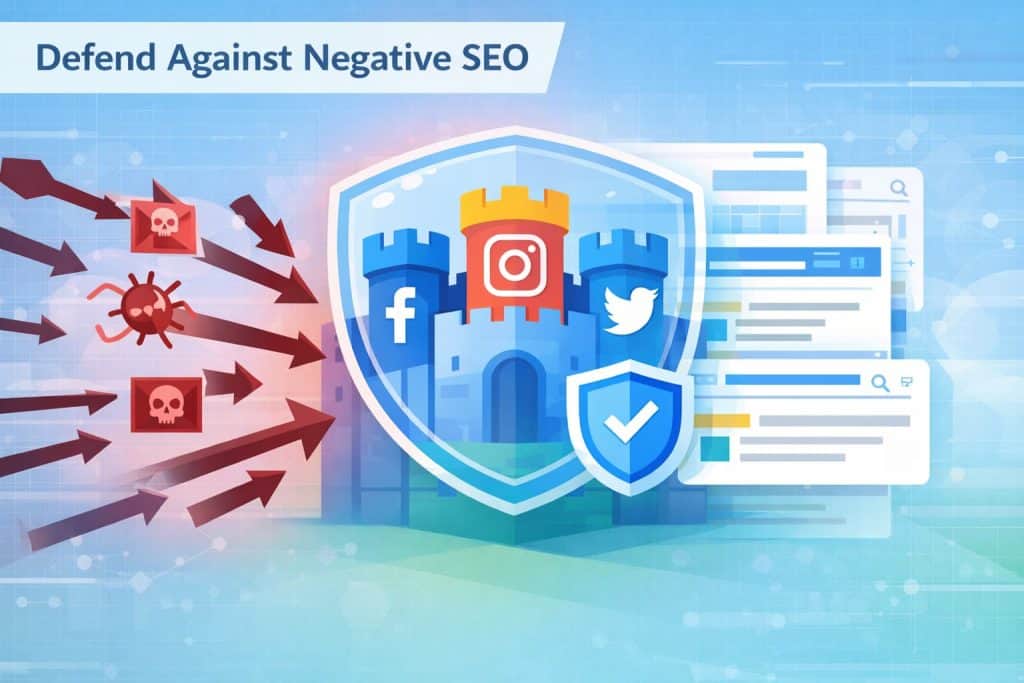
It can support reputation management by helping you control more of page one for your brand name.
The vast majority of searcher attention and clicks occur on the first page of results, especially for branded queries, so owning more of that page matters for perception and control. When your official social profiles rank alongside your website, they reinforce legitimacy and give searchers clear, trusted options.
A properly maintained fortress can:
This only works if the profiles actually rank for your brand keywords and stay active. Empty accounts do not protect anything.
Think of it as reinforcement, not armor. It strengthens your presence. It does not make you untouchable.
Important: Combine social fortress with active online reputation management, review generation, and content marketing for comprehensive brand protection.
Our local SEO packages include reputation management strategies.