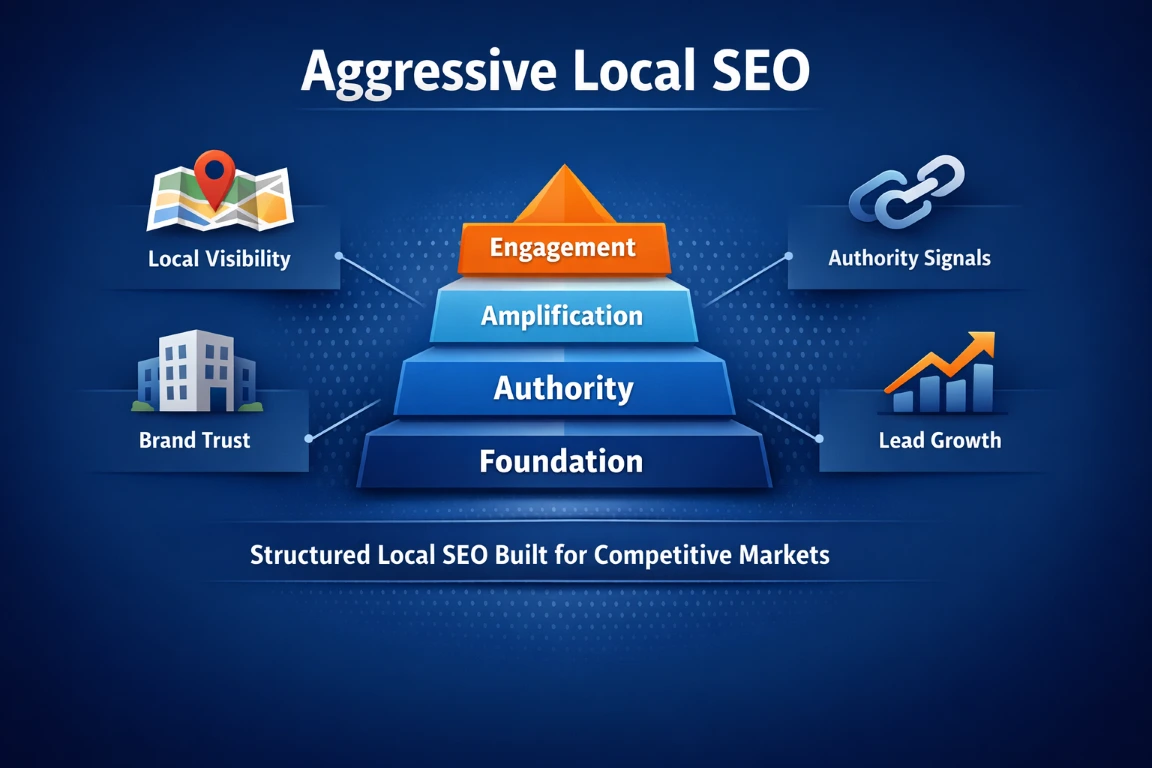
A Proven System to Dominate Google Maps & Local Search
Google evaluates trust, authority, consistency, and user engagement across multiple platforms before deciding which businesses deserve top visibility in local search results.
This guide explains the Aggressive Local SEO system used by Lucky Digitals to help businesses rank higher in Google Maps, Local Finder, and organic results—especially in competitive cities and service areas.
No fluff. No theory. Just execution.

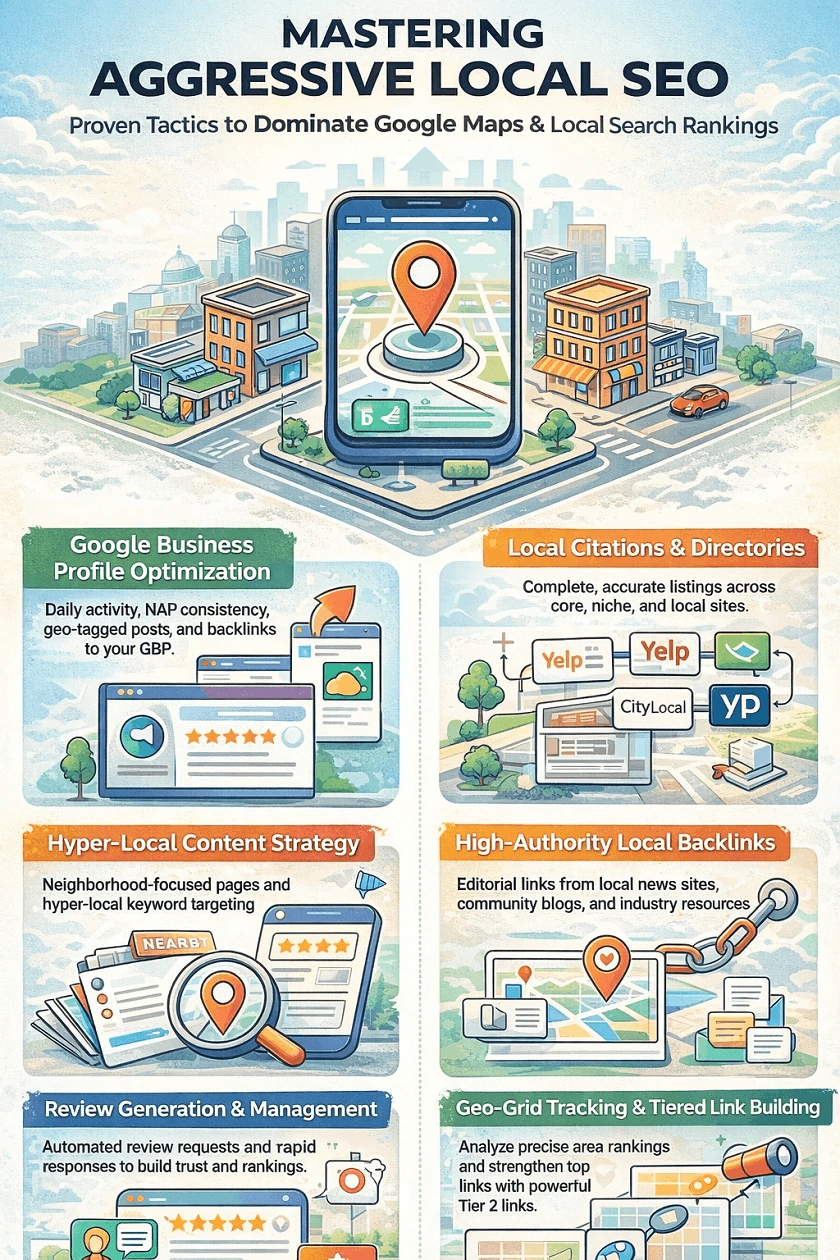
Aggressive Local SEO is a multi-layered ranking strategy designed to accelerate visibility by strengthening every local ranking signal Google uses.
Instead of relying on one tactic (like citations or backlinks alone), aggressive Local SEO focuses on:
This approach is essential for businesses competing in saturated markets where standard Local SEO is no longer enough.
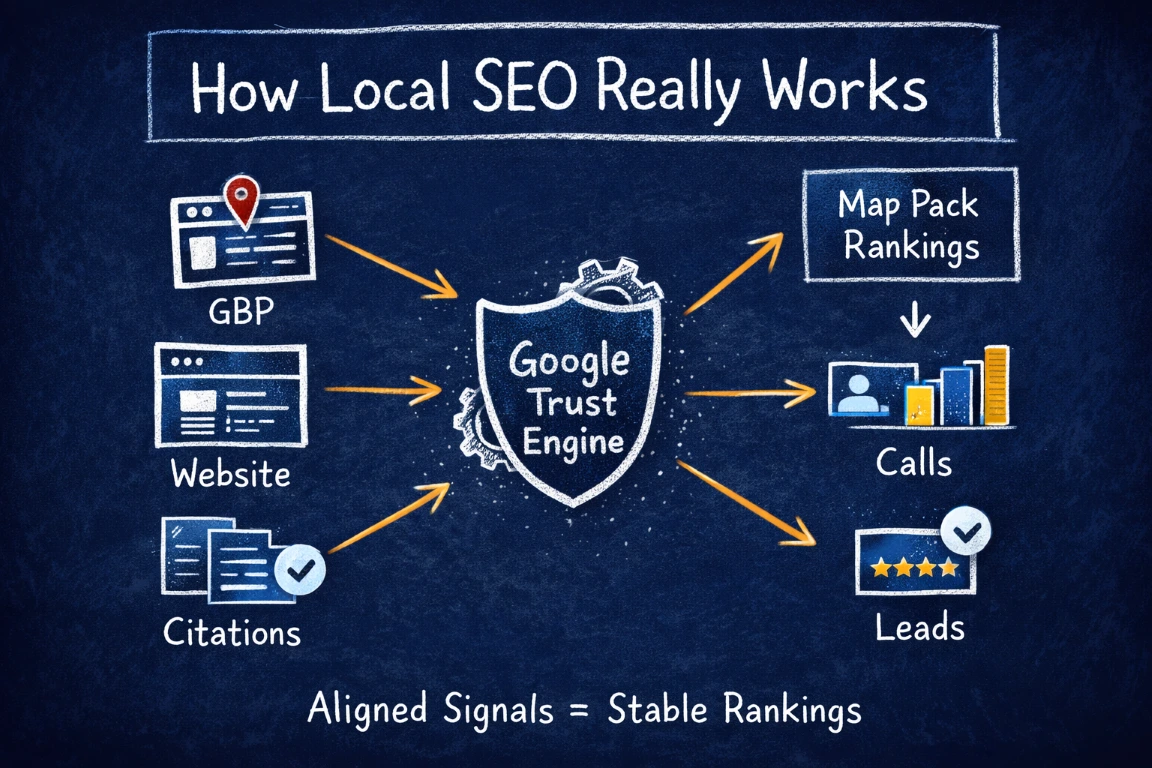
Google evaluates local businesses using three core factors:
How closely your business matches the search query and intent.
How close your business is to the searcher’s location.
How well-known and authoritative your business appears online.
Aggressive Local SEO works by influencing all three factors simultaneously, instead of optimizing them in isolation.

Google no longer ranks “websites” in isolation. It ranks entities.
Your business is evaluated using multiple overlapping systems:
If any of these are weak, rankings stall. That’s why most local SEO campaigns fail.
This guide shows how to build all of them together.
The Core of Local Rankings
Your Google Business Profile is the #1 driver of local visibility – and if it’s incomplete, inactive, or inconsistent, you can be invisible in the Map Pack even if your website SEO is good.
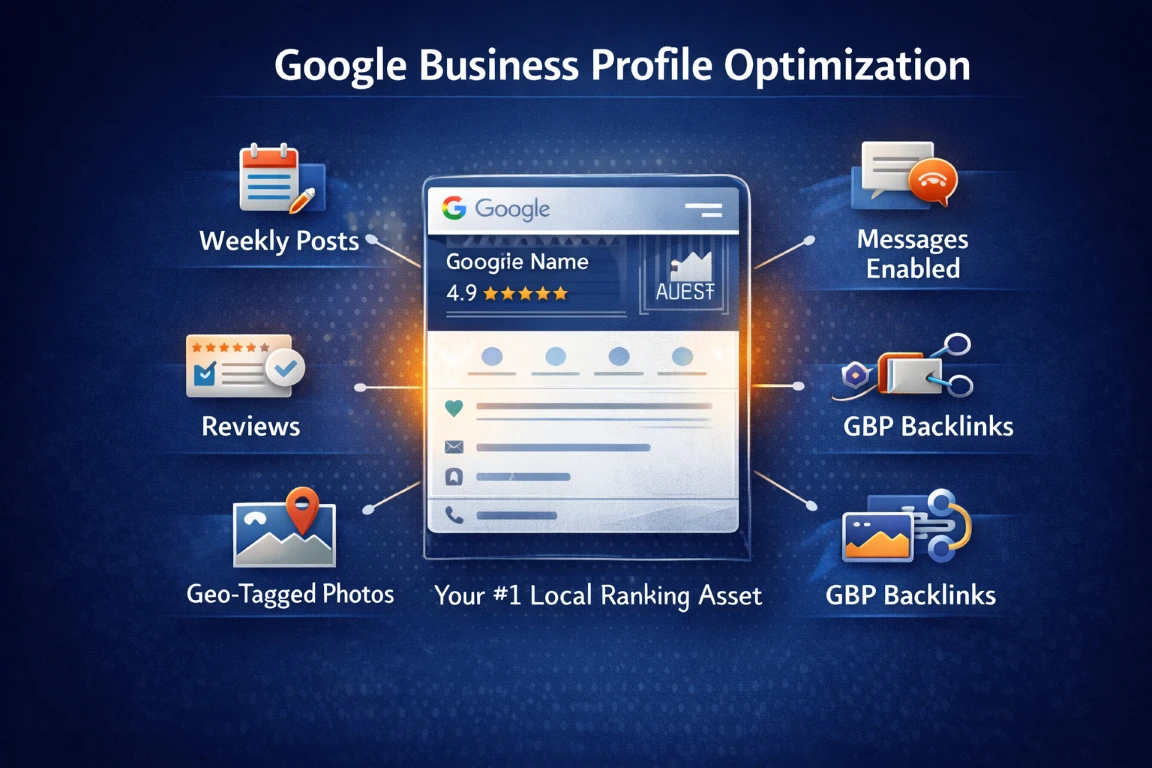
We treat GBP like a high-conversion landing page, not just a directory listing.
Without a fully optimized GBP, your local SEO has no foundation, and this layer directly supports calls, direction requests, messages, and visibility.
The guide notes GBP optimization can increase profile views by 100–300% and signals freshness/relevance/legitimacy to Google.
A fully optimized GBP acts as the command center for all other Local SEO strategies.
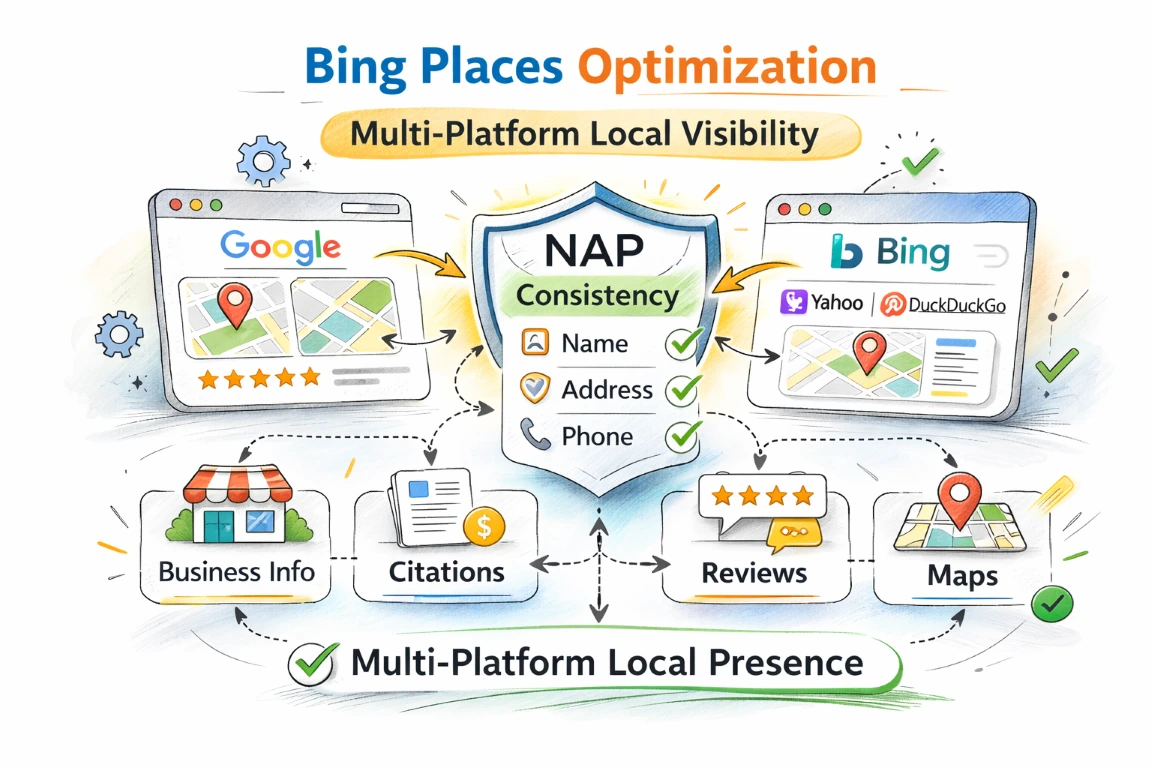
Don’t Ignore the Second Search Engine. Bing powers Yahoo, DuckDuckGo, and Microsoft Start, and can drive qualified traffic—especially in B2B, enterprise, and older demographics.
This layer ensures you appear consistently across major search ecosystems.
Sync with GBP data (exact NAP, categories, hours—no discrepancies)
Better NAP trust (consistency reinforces legitimacy in Bing’s local algorithm)
Extra authority (Bing Places can earn backlinks and visibility on Microsoft properties)
The guide emphasizes many agencies skip Bing, but this layer can:
The Trust Grid Google Cross-Checks
Google verifies your business by cross-checking your NAP across hundreds of directories and data sources.
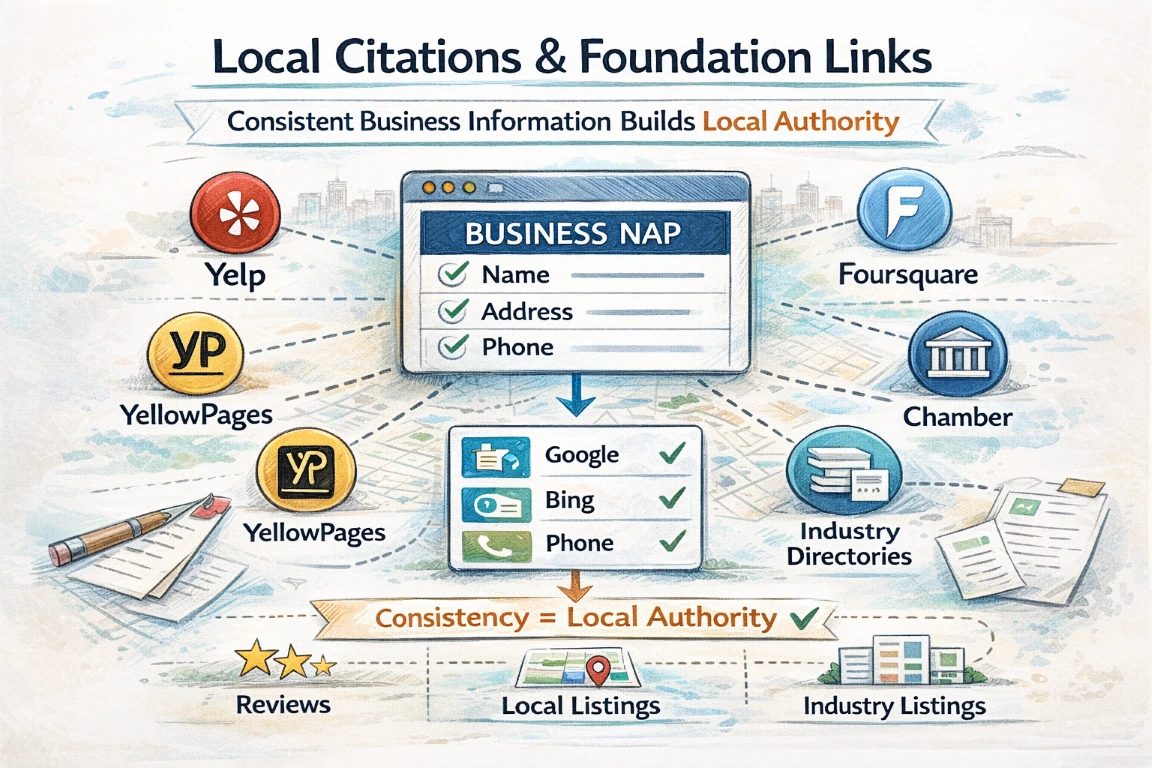
If your information is inconsistent—even a typo—your business can lose trust, authority, and rankings.
The guide summarizes citation benefits as:
In simple terms:
more consistent citations → higher trust → higher rankings → more calls and leads
A triple layer strategy. We don’t submit random directories—we build a structured ecosystem.
Layer 1: Top citations (core directories)
Examples include Yelp, Yellow Pages, Hotfrog, Foursquare.
Layer 2: Niche citations (industry specific)
Niche directories outperform generic ones by improving relevance.
Layer 3: Hyper-local citations (city/community trust)
Chambers of commerce, local associations, city directories, community forums—critical for competitive service areas.
We analyze top competitors and extract the citations they use – if they have it, you get it; if they don’t, we build better.
Before building, we audit for incorrect NAP, duplicates, incomplete profiles, wrong categories, and outdated details – then fix everything so Google sees one clean version.
Also known as Social Fortress Links.
Every local SEO journey begins with brand credibility—without it, Google may not trust your business even if you’re the best in town.
A Social Fortress is a network of branded profiles on 100+ high authority platforms (DA 80+), all presenting a unified identity and local relevance.
This foundation establishes credibility and local trust, speeds indexation for your website/GBP, strengthens E-E-A-T, and prepares you for advanced tactics (links, GBP work, parasite SEO).
Google rewards sites with unique, valuable content that people want to reference—so we create assets designed to earn links, shares, and engagement naturally.
These assets attract organic backlinks, increase time on site, reduce bounce rate, diversify content profile, and build topical authority.
Injecting Real Local Authority

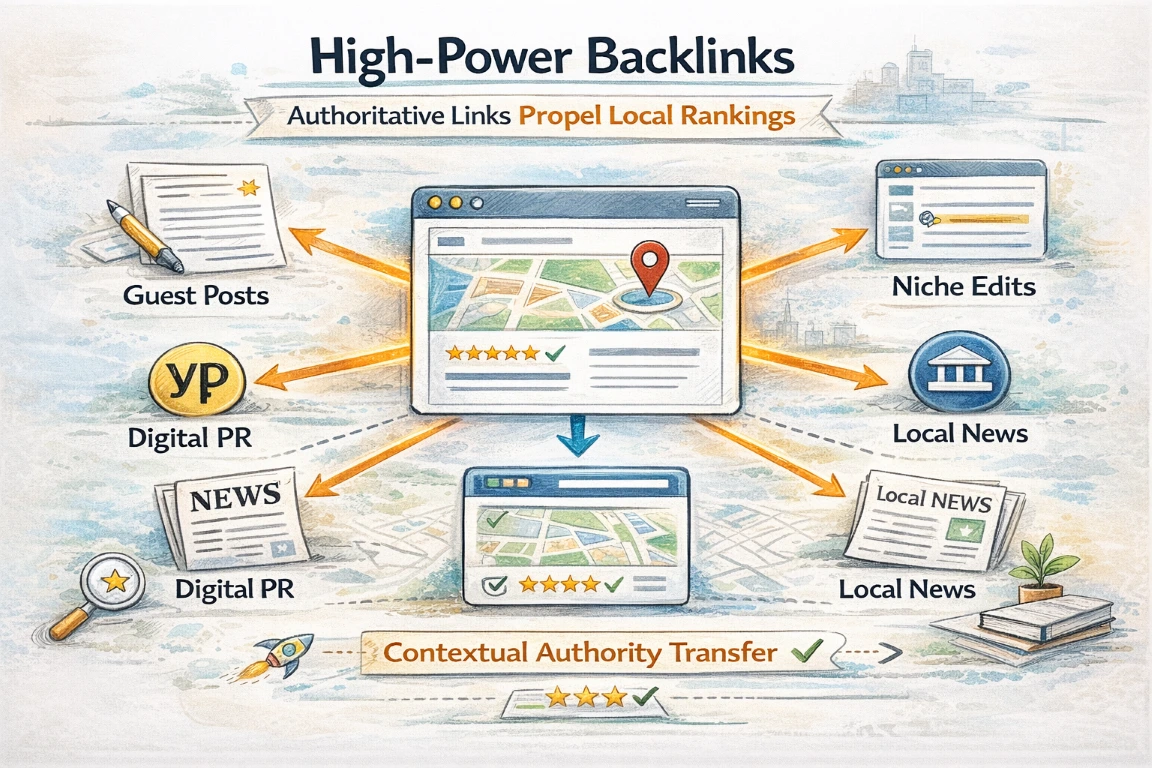
Not all links move the needle—this focuses on editorial, contextual, high-impact placements.
Borrowing Authority to Rank Faster
Instead of waiting weeks/months for a local site to build authority, Parasite SEO helps you rank faster by publishing on platforms Google already trusts.
The guide calls out trusted domains like Google Sites, WordPress.com, Medium, Vimeo, Behance, and more.
A network of branded, interlinked mini-sites across trusted ecosystems (Google Stack, GEO-optimized Web 2.0 blogs, video/image profiles).
The guide notes benefits like: indexing and ranking within 3–14 days, pushing authority signals through trusted domains (especially Google Sites), diversifying local footprint, and creating a buffer before more aggressive campaigns.
Amplify What You Already Earned

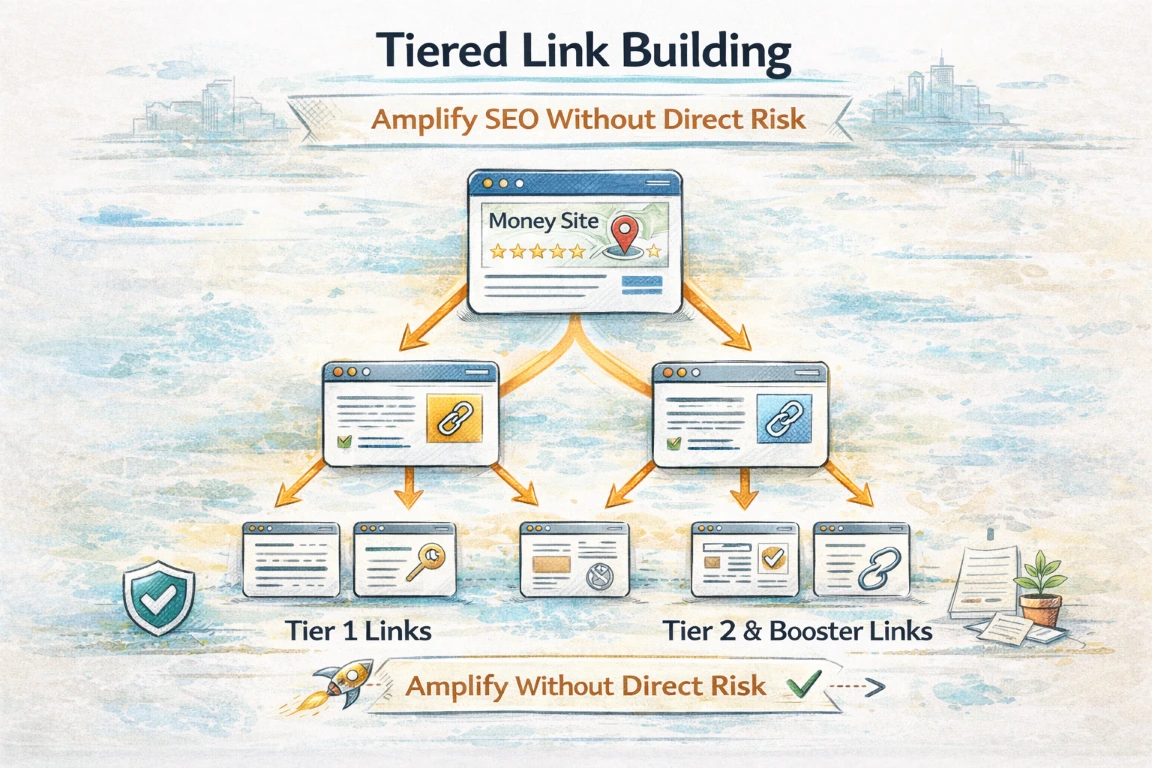
Once you have strong Tier 1 links, you can increase their impact with a structured tiered setup.
Step 1: Identify Tier 1 links (guest posts, niche edits, parasite pages, crowd/forum links).
Step 2: Send booster links (social bookmarks, pastebin-style links, link-in-bio/profile links, contextual blog/wiki links).
Step 3: Tier 2 & indexing (web 2.0 submissions, wikis, article directories, extra bookmarks, indexing services).
Turn Local Searches Into Real Engagement
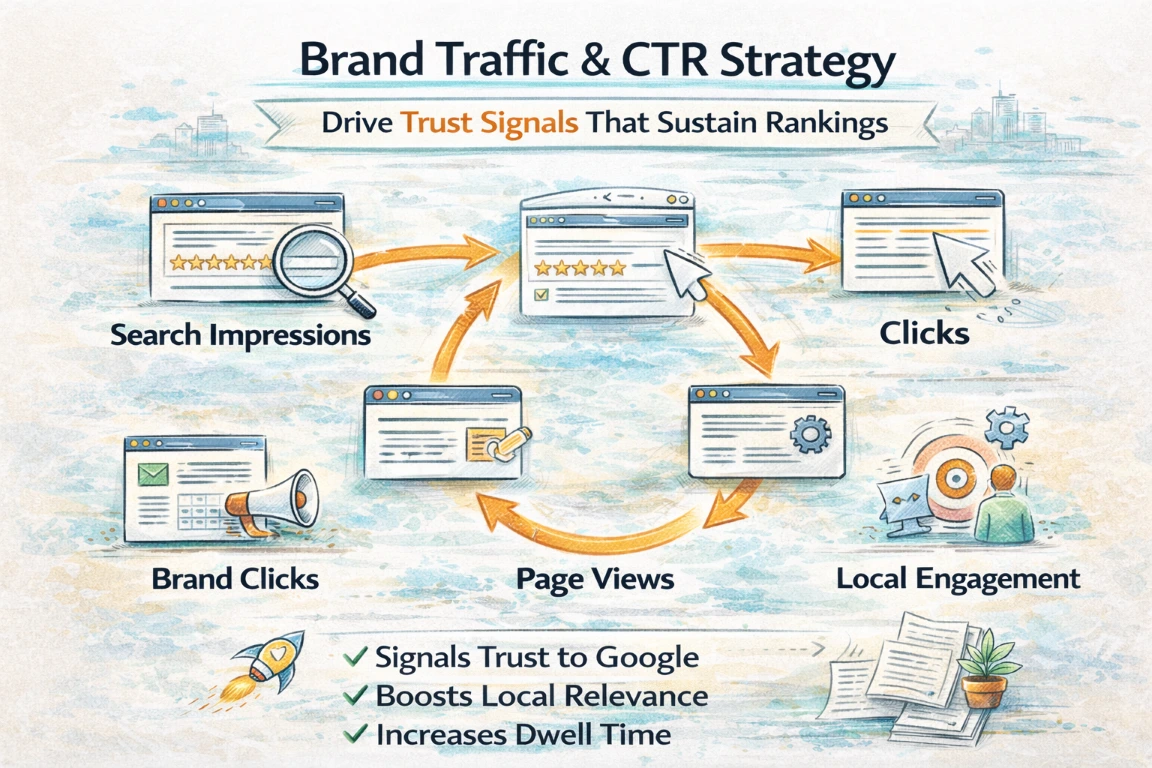
Google watches how users interact with local listings. If users click, stay, and take action, Google assumes relevance and can reward rankings.
The guide focuses on measurable engagement signals: search CTR, dwell time, on-page engagement, and return/direct visits.
Use this section on the landing page to frame a clean, white-hat approach (while still matching the guide’s intent):
Standard Local SEO |
Aggressive Local SEO |
|---|---|
Local SEO works only when done consistently. Each pillar—GBP optimization, citations, links, and engagement—builds on the others to create steady growth, and these tasks must be done regularly to stay visible and competitive.
This page gives you the overview. The ebook gives you the execution.
The most important local SEO ranking factors in 2026 are relevance, distance, and prominence, supported by trust and engagement signals.
In practice, this includes:
Businesses that address all ranking layers together tend to outperform those relying on basic Local SEO tactics.
Hyper-local content improves Google Maps rankings because it matches localized search intent more precisely.
When pages reference specific neighborhoods, service areas, landmarks, or ZIP codes, Google sees stronger relevance signals for searches like “plumber near Downtown Dallas” or “dentist in South Miami.”
This approach reduces competition, improves local relevance, and expands your visibility beyond a single city-wide listing.
Google does not publish an exact number, but businesses with 50+ consistent, high-quality citations tend to rank more frequently in the Map Pack.
What matters more than volume is:
Inconsistent or duplicate citations can weaken trust, even if you have many listings.
Yes, schema markup helps local SEO by making business data easier for search engines to understand and verify.
LocalBusiness schema reinforces:
While schema alone won’t guarantee higher rankings, it strengthens trust signals and improves eligibility for rich search results.
Your Google Business Profile should be updated consistently, not just once.
Best practices include:
Ongoing activity signals freshness and legitimacy, which can improve both visibility and engagement in Google Maps.
Yes, aggressive local SEO is safe when executed correctly and strategically.
Aggressive does not mean spammy or manipulative. It means proactive and comprehensive. A safe aggressive local SEO strategy focuses on:
Risk usually comes from shortcuts like fake listings, spam links, or automated tactics. When aggressive SEO is built on quality, consistency, and real signals, it aligns with Google’s guidelines and delivers sustainable results
Results depend on competition, location, and your current online presence, but aggressive local SEO typically produces faster movement than standard approaches.
In general:
Because aggressive local SEO strengthens multiple ranking signals at once, it reduces the waiting period common with slower, one-dimensional strategies.
Standard local SEO focuses on basic compliance, while aggressive local SEO focuses on competitive dominance.
Standard local SEO typically includes:
Aggressive local SEO goes further by:
In competitive markets, aggressive local SEO is often the difference between being visible and being chosen.